Listed Building Stonework Repair Somerset: Expert Stone Restoration for Historic Buildings in the South West of England

From all of us at Vitruvian Stonemasonry, we would like to wish our clients, collaborators and custodians of historic buildings a very happy New Year and all the best for 2026.
Caring for a listed building is both a privilege and a responsibility. At Vitruvian Stonemasonry, we specialise in Listed building stonework repair in Somerset, working with property owners, architects, conservation officers and estates to protect historic stonework while respecting the building’s past, present and future.
Founded in 2014, Vitruvian Ltd is a dedicated team of stonemasons, conservators and heritage specialists based in the South West of England. Our work combines traditional craftsmanship with modern conservation knowledge, allowing us to deliver sensitive, durable and historically appropriate repairs to some of the region’s most important buildings.
Table of Contents
What Makes Listed Building Stonework Repair in Somerset Different?
Our Conservation Philosophy
Common Stonework Problems in Somerset’s Listed Buildings
Our Approach to Listed Building Stonework Repair Somerset
Materials, Mortars & Traditional Techniques
Experience You Can Trust
Integrated Heritage Services
Frequently Asked Questions
Key Takeaway & How to Contact Us
What Makes Listed Building Stonework Repair in Somerset Different?
Somerset’s built heritage is defined by its local stone. From Bath stone façades to rubble limestone walls and finely carved dressings, each building reflects centuries of craftsmanship and local geology.
Listed building stonework repair in Somerset differs from modern construction for several key reasons:
Legal Protection and Heritage Controls
Listed buildings are protected by law, meaning repairs must preserve the building’s special architectural or historic interest. Even small stone repairs may require consent, and inappropriate work can cause long-term harm or enforcement issues.
Breathable, Traditional Construction
Historic buildings were designed to manage moisture naturally. Solid stone walls, lime mortars and vapour-permeable finishes all work together. Introducing hard cement or modern materials can disrupt this balance, trapping moisture and accelerating decay.
Cumulative Damage from Past Repairs
Many listed buildings suffer not from age alone, but from well-intentioned yet inappropriate repairs carried out decades ago. Cement pointing, resin fillers and incompatible stone often cause more damage than the original defect.
Age, Movement and Patina
Historic buildings move. Settlement, thermal expansion and seasonal moisture changes are normal. Repairs must accommodate this movement while respecting the building’s character and patina, rather than attempting to make it look “new”.

Our Philosophy on Listed Building Stonework Repair Somerset
“Conservation is not about perfection — it’s about understanding how a building wants to behave and working with it, not against it.”— Vitruvian Stonemasonry
Our approach to listed building stonework repair in Somerset is rooted in three principles:
Minimum intervention – We only replace stone when repair is no longer viable.
Material compatibility – New work must be physically and chemically compatible with historic fabric.
Longevity – Repairs should last decades, not just look good on completion day.
Every project is treated as a unique structure, not a repeatable system.
Common Stonework Problems in Somerset’s Listed Buildings
Through surveys and restoration projects across Somerset, we frequently encounter the following issues:
Stone Erosion and Surface Loss
Exposure to wind-driven rain, pollution and frost can gradually erode stone surfaces, softening details and weakening masonry. Bath stone and limestone are particularly vulnerable when moisture movement is restricted.
Cement Pointing and Trapped Moisture
Hard cement mortars are one of the most common causes of stone decay. They prevent evaporation, forcing moisture through the stone instead, leading to spalling, cracking and salt damage.
Failed Historic Repairs
Incompatible stone indents, resin repairs and synthetic fillers often fail over time, visually disrupting façades and accelerating deterioration of surrounding stone.
Structural Cracking and Settlement
Historic movement can manifest as stepped cracking, open joints or displaced masonry. These issues require careful assessment before any repair strategy is implemented.
Salt Crystallisation and Damp
Salts introduced through groundwater, pollution or previous treatments crystallise within the stone as moisture evaporates, causing internal stress and surface breakdown.
Our surveying and consultation service allows us to diagnose these problems accurately and propose solutions tailored to each building.
Our Approach to Listed Building Stonework Repair Somerset
1. Survey, Analysis & Advice
Every project begins with a thorough understanding of the building. We assess stone condition, mortar composition, moisture movement and previous interventions, producing clear recommendations and phased schedules where required.
2. Heritage Liaison & Consent Support
Where listed building consent is needed, we assist with technical descriptions, method statements and material specifications to support smooth approvals.
3. Skilled Stone Repair and Replacement
Our core Stonemasonry services (https://www.vitruvian.ltd/stonemasonry) include:
Plastic stone repairs using lime-based mortars
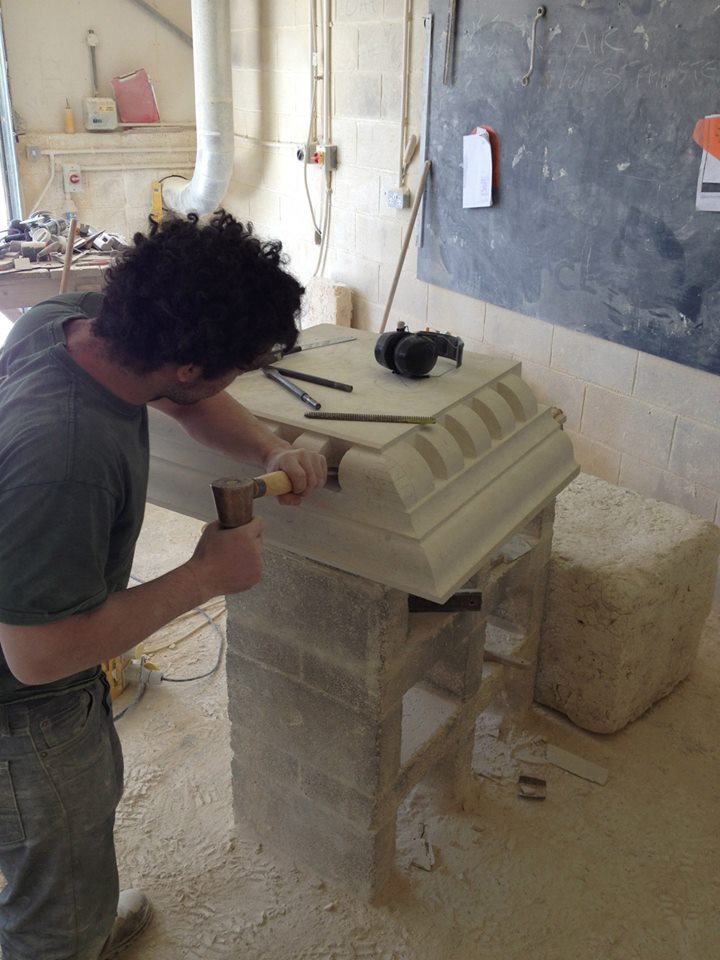
Hand-carved stone indents matched for colour, grain and tooling
Careful dismantling and rebuilding of unstable masonry
Conservation cleaning where appropriate
All stone is worked from our banker shop near Bath, ensuring control over quality and finish.
4. Lime-Based Mortars and Finishes
Through our specialist Lime Works (https://www.vitruvian.ltd/lime-works), we select appropriate lime products — including lime putty, hot lime mixes and NHL mortars — based on exposure, stone type and historic precedent.

Materials, Mortars & Traditional Techniques
Listed building stonework repair in Somerset demands material literacy. We work with:
Locally sourced and geologically compatible stone
Traditional hand tools to replicate historic finishes
Vapour-permeable lime mortars and renders
Techniques that allow future conservation without damage
Modern understanding supports our work, but traditional craftsmanship delivers it.
Experience You Can Trust
Our team’s experience includes work on some of the UK’s most significant historic buildings, including:
The award-winning restoration of Tyntesfield Orangery
Blenheim Palace
Churches, monuments and National Trust properties
Georgian and Victorian listed homes across Somerset
Whether large-scale or domestic, the same standards apply.
Integrated Heritage Services
Many listed building projects require coordinated specialist input. Alongside stonework repair, we provide:
Construction for heritage and bespoke builds (https://www.vitruvian.ltd/construction)
Bespoke metalwork integrated sympathetically into stone (https://www.vitruvian.ltd/metalwork)
Specialist carpentry for historic structures (https://www.vitruvian.ltd/carpentry)
Full restoration from derelict to renewed (https://www.vitruvian.ltd/restoration)
Traditional letter cutting for plaques and memorials (https://www.vitruvian.ltd/letter-cutting)
Sculptural and architectural commissions (Commissions)
This joined-up approach ensures consistency and quality across every stage.
Frequently Asked Questions – Listed Building Stonework Repair Somerset
Do all stone repairs need listed building consent?
Not always, but many do. We recommend seeking advice early to avoid issues later.
Why can’t cement mortar be used?
Cement is harder than historic stone and prevents moisture evaporation, leading to accelerated decay.
Can original stone always be saved?
Often, yes. Repair is always considered before replacement, but severely decayed stone may need careful renewal.
Do you work with private homeowners?
Yes — many of our listed building stonework repair Somerset projects are private residential properties.
Can you help plan future maintenance?
Absolutely. Preventative maintenance is key to long-term cost control and conservation.
Key Takeaway & How to Contact Us
Listed building stonework repair in Somerset requires expertise, patience and respect for history.At Vitruvian Stonemasonry, we take pride in delivering repairs that are structurally sound, visually harmonious and built to last.
If you are responsible for a listed building and would like expert advice, surveys or stone restoration carried out with care, we would be delighted to discuss your project.
We look forward to working with you in 2026 and beyond.


Comments